
Around 6,000,000 years ago[1], an ape ancestor, after discovering a piece of fruit, suddenly had an impulse to share the happiness and information – it then awkwardly pointed to its fellows and made a gesture: there is food here. Years passed, and countless similar attempts followed, across which the small exchanges of environmental information were shown statistically useful for survival. Natural selection then preserved this tendency toward group communication, gradually etching it into the nature of humans as “social animals”. As this tendency carried forward through time, communication did more than only transmit resources and dangers; it also taught individuals to check their perception with others. To be recognized by others of the same kind then came to mean “safe”; it meant “the world I see is correct, is the same as everyone else’s”. This is probably why at a deep psychological level, we seek recognition, applause, labels, and standardized metrics. All of those are proxy signals saying “I am safe because I have not been abandoned by my kind”. Given our inherited social nature, our confidence is basically never formed by the self alone. Here I use the word confidence in a very specific sense. It does not mean arrogance or optimism, but the degree to which we are willing to trust our own perception. We learn to trust what we see partly through the responses of others: whether they follow our signal, understand our words, recognize our judgment. When those responses are absent, the problem is not only that we feel disliked; something deeper is shaken: our willingness to trust our own perception. Low confidence, in this sense, is the suspicion that one’s way of seeing the world may be unreliable. Then, the question I want to discuss, is not whether we need recognition, but which audience we allow to anchor our confidence.
The Crowd
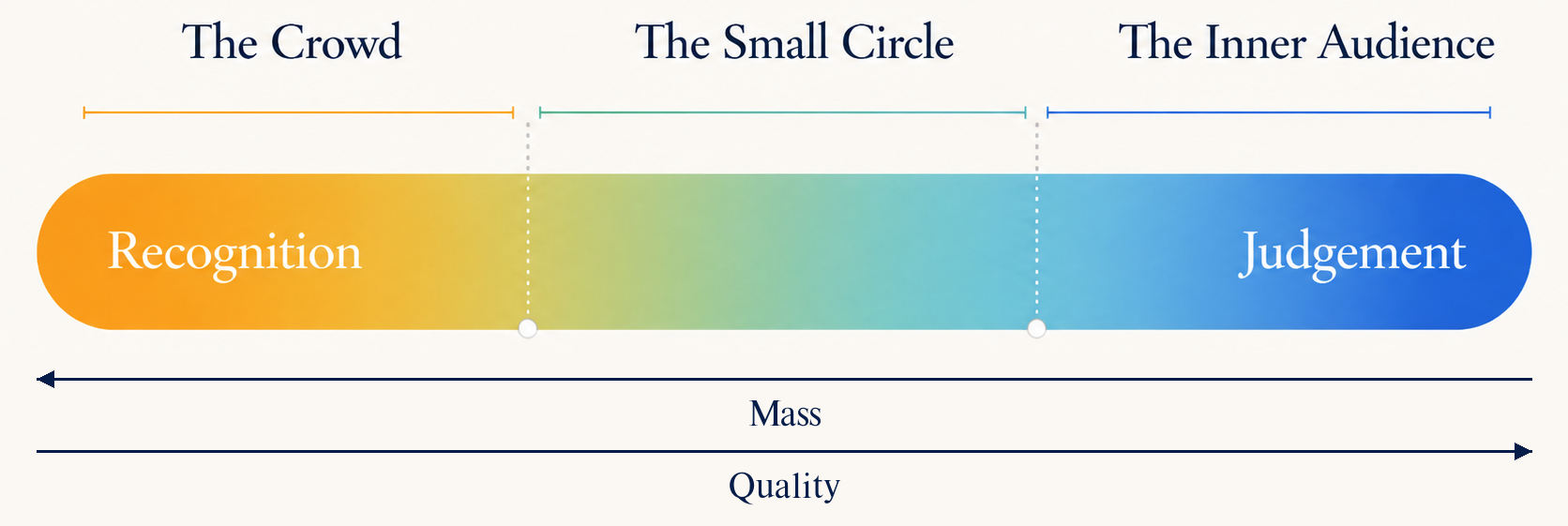
The first audience is the crowd: the vast, anonymous public of other human beings.
As the most direct and visible signal source, the crowd provides popularity and labels immediately, and delivers rapid and visible feedback. In some sense, these signals are useful: they help us evaluate whether our thought has reached others, resonates, and can travel through the social world. However, transmissibility does not equal high quality. Among all possible features of a thought, it amplifies what travels fast: visibility, emotional resonance, and ease of repetition. An idea may spread because it’s easy to carry, not because it’s deep enough. What’s more, the crowd is a distribution of judgment instead of a single standard. Some people in it are sharp; others respond mostly to visibility, mood, or the surface texture of an idea. Here I refer to quality as a practical standard: whether an idea can be internalized by another capable mind, and continue to generate sound judgment. A high-quality idea is not merely one that spreads. It is one that remains useful after transmission. It enables others to see clearly, make sharper distinctions, or recognize patterns that were previously invisible.
The Small Circle
This is why a smaller audience can sometimes become a stronger anchor of confidence.
The small circle is selected from the crowd, usually from the high-quality tail of noisy mass signals. The point is not to escape the crowd, but to sample more carefully. The small circle tends to ask more profound questions – whether the idea can be inherited, can be extended without collapsing, whether it can create sharper distinctions and more reliable judgment. Questions like these require more than reaction; they require the ability to run the idea. This is the difference between popularity and productive inheritance. This small circle is important because it can examine distinctions that the general public often overlooks: between emotional slogans and profound words, between propaganda and enduring ideas. Recognition from the right few can therefore matter more than applause from many, not because the few are morally superior, but because their signal is more precise. But this is still not the end. As long as the small circle remains external, confidence is still outsourced.
The Inner Audience
The next step is not to remove the audience, but to internalize it. If the crowd is the whole distribution of judgment, and the small circle is the high-quality tail we choose, we may seek something one level deeper: the generative mechanism behind those high-quality judgments. The small circle gives us verdicts: this is either deeply promising or empty – the verdict is still external. What really matters is whether we can gradually understand how such verdicts are produced.
The inner audience is not simply a matter of “trust ourselves”. Blind self-trust can easily become self-deception. A good inner audience must first be trained by contact with capable minds, observing what they notice, what they ignore, and why they are sharp. Over time, their judgments stop being only outside responses and become internal criteria. We begin to ask, before anyone else sees the idea: can this survive inside a capable mind? Is this only decorative, or does it actually generate better judgment? Is this just a sentence that sounds deep, or a real structure? In this sense, the inner audience is stronger than the small circle, because it no longer waits passively for feedback. It participates in the formation of thought itself, dynamically interrupts weak intuitions, sharpens vague structures, and turns recognition from an external signal into an internal standard.
Perhaps this is the highest form of recognition: not being free from all audiences, but becoming worthy of being our own best audience. Finally, the crowd gives resonance. The small circle gives precision. The inner audience gives form.
Postscript
At this point, my own need for recognition becomes clearer. I don’t think I only want applause. However, honestly, I cannot say that I pursue beauty in complete isolation. What I want is more specific: I want the people whose judgment I trust to examine what I see. In this way, I know my intuition has survived within a capable mind. Furthermore, I’m trying my best to build a high-quality inner core from a small audience. Maturity, then, in my view, is not self-isolation, but the training of the audience: from the crowd that sees us, to the few who can judge us, to the inner standard by which we learn to see ourselves.
Of course, a perfect inner audience is only an ideal case. Even the most talented one cannot build a flawless oracle inside; thus, we still more or less need external calibration. Similarly, even the most solitary person needs, somewhere, some form of external recognition – this is due to the genetic instinct of us as social animals. But the point is to make this dependency cleaner. We need external judgment to keep our direction, but not so much that our confidence is held hostage by everyone. The small circle also needs updating. It is not a fixed list of people, but a changing source of high-quality judgment: to acquire valuable judgments, while gradually letting unhelpful voices fade into the background.
Alexander Grothendieck
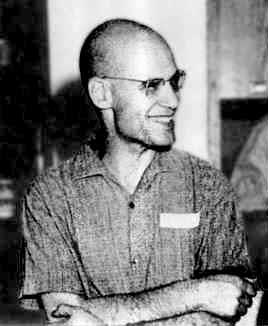
Grothendieck once wrote that he had spent years building “houses that an inner voice (or an inner demon…) called for me to build”[2]. This is perhaps the extreme case of a man whose judge had moved inward, and who later lived a secluded life for decades until his death.
Konrad Jacobs/MFO, CC BY-SA 2.0 DE

References:
- Genetics, Smithsonian National Museum of Natural History, Human Origins Program.
- The mysterious disappearance of a revolutionary mathematician, The New Yorker.